Wednesday, December 09, 2015

The guy who wrote the Thesen Islands Design Guidelines (hyperbole!) and past Chairman of the Design Review PaneI gives his view on the Wall


I asked my brother, Gray Rutherford*, to give his opinion on the boundary wall at P76, as there is no one better qualified than him to give an objective interpretation of the Guidelines.  
I requested Henk Booysen, General Manager of the TIHOA to table his opinion below at both the Trustees meeting on 8 December and the Design Review Panel meeting of 10 December, 2015. 
==================
Dear Ken,

Boundary Wall at P76 Thesen Islands

As the co-ordinator and compiler of the Thesen Islands Design Guidelines and Chairman of the Design Review PaneI for a number of years you requested my views on the above. They are as follows:

The boundary wall should not have been approved by the Thesen Islands Design Review Panel for a number of reasons, but primarily and most importantly:

It does not adhere to the Thesen Islands Design Concept set out on the first page of the Guidelines. The Design Concept specifies white timber picket fencing along property boundaries. This should be the first test of the Design Review Panel and as it fails it, the DRP would have no need to address the detail. 

However, I will take it further:

1. The use of a later (flawed) definition of a lane to the original Guidelines that somehow permits high boundary walls is clearly in conflict with the Design Concept.  A lane is simply a narrower street. It has the same requirements.

2. The argument that because this property has a zero building line where the fence is situated permits a boundary wall is incorrect.  It is a zero building line i.e, for buildings, not walls.

3. The Boundary Fences section in the Guidelines (note the heading is not Boundary Fences and Walls) is specific regarding Lanes and Courtyards.  It refers to fences only.

4. The only place where limited boundary walls may have been permitted in certain circumstances is in Concept Design and Regulation Plans (sometimes referred to as “Site Specific”) for certain small (usually less than 500 sq.m) property precincts.  P76 is not in one of these areas.

5. The wall colour is blue. The fence it has replaced would have been white.


Gray Rutherford      4 December 2015
================================

(1) If you are a recent arrival in Knysna, you may be wondering what Gray Rutherford had to do with Belvidere Estate & Thesen Islands. Belvidere Estate is a result of his vision and Thesen Islands would not have happened without him. Gray doesn’t see the need to shine the light on his achievements, which opens the door for others to misappropriate as their own.       
Read:
"The Belvidere Estate Story - By Pixie & Mick Roberts" in the blog.

Hyperbole: Exaggerated statements or claims not meant to be taken literally.


Wednesday, December 02, 2015

The first 1.8m street facing brick wall...


Yes, folks. We have taken the first step to living behind high walls on Thesen Islands. The first 1.8m high brick wall has just been built at P76.

So now you can recapture the feeling you had in Johannesburg or Cape Town living behind a high wall. Block the view of your neighbours walking past. Don't like 'em anyway.  Maybe add electric fencing on the top. Keep 'em out!  

If every homeowner in this lane builds a 1.8m wall, all choosing to paint it in their own house colours, this “lane” would have checkered 1.8m walls down both sides. It would look like a very average townhouse complex in Cape Town or Johannesburg, but definitely not Thesen Islands.  

If you feel this a a good idea let the HOA know. Then the Design Review Panel can  retroactively change the Design Guidelines to allow this. But, you ask, this wall must have been approved?  Yes, it was. Even though the Thesen Islands design philosophy and the actual Guidelines don't allow it. 

If, like me, you think this is a huge blunder that has serious consequences for the look and feel of Thesen Islands and, yes, is a threat to our property values, then write to the HOA and tell them. 

The HOA trustees, committee members and staff are well intentioned, work hard and want to make Thesen Islands the best it can be. And we home owners must be thankful that there are home owners who donate their time and skill to be trustees & committee members. We must not forget that. 

Thesen Islands belongs to all of us. And we need to look after it. Home owners need to interact with the trustees, committees and staff to let them know what we think and see. If we hadn't done that a year ago when the scheme was floated to sell off the Parkland, we'd be looking at bulldozers today. And builder's trucks 5 days a week for a few years all the way from Waterfront Drive to the far end of the Islands.  For a few more cents in our pockets. And a lot of Rands in other pockets.    

Aside from a letter I have written directly to the Design Review Panel , I have written this to the Trustees of the HOA:


2 December, 2015

Trustees of the Thesen Islands Home Owners Association

Dear Trustees,

The Design Review Panel has made a stunning error approving a 1.8m high masonry street facing wall recently built at P76. Blunders like this will change the look and feel of Thesen Islands irreversibly.  

If you think I am being alarmist, please read the attached 2013 letter to Richard Wilkinson from my brother Gray Rutherford (1) regarding the experiences at Belvidere Estate when their Architectural Committee took “ …a more accommodating approach.”   

(Reading on the blog?: See " Gray Rutherford on the pitfalls of a more accommodating approach..." for this letter.) 

This 1.8m wall should never have been approved. Not from what Thesen Islands is meant to be, nor the specific requirements for street facing fences.

Here is what our website says about the design philosophy for Thesen Islands (bold added by me):

The New Urbanist, or Traditional Neighbourhood Design philosophy, underlies the design concepts and planning of Thesen Islands. 

Livable neighbourhoods are those built to reduce dependency on cars, provide easy access to public and commercial amenities, increase community interactivity, improve cost-effectiveness of services and provide a simplified but higher quality of life. The focus is on the pedestrian as opposed to the motor vehicle. Buildings, open spaces, streets and walkways are scaled down for the pedestrian to experience and relate to with enjoyment and appreciation. 


And from the Design Concept at the beginning of the Design Guidelines:

The Islands’ architecture is “Colonial Maritime” – identifying with Knysna’s historic vernacular architecture and seafaring connection. The concept is based on criteria derived from Cape Colonial buildings, but without the Victorian embellishments. The concept emphasizes simplicity, human scale and vertical proportions, traditional plan form, harmony, refined details and natural colours. Buildings are smooth plastered brick or timber clad frames. Wooden verandahs, decks, railings, boardwalks, gazebos and picket fencing reflect the Thesen Islands’ and Knysna’s timber heritage

Then if you read further in the Guidelines:   

D35. Boundary Fences Apart from their visual appeal the Thesen Islands picket fences define the edge and scale of the streets. The pickets reinforce the vertical vernacular form. See definition of Picket. No part of a fence or wall may extend over the property boundary.

Street facing fence: A fence of an approved picket design in treated timber or approved composite material with timber proportions and painted white between 0.6 and 1.2 metres in height must be erected along the entire street and parkland boundary of the property or the outer estate lagoon facing boundary. These fences must have posts placed on the private side and face towards the public areas or be both side friendly. Street and public facing picket fences must have 40% openings for example if the picket is 100mm wide, an opening of 40mm must be between pickets. Gate width not to exceed 6.5 metres.

Lanes and Courtyards have site specific designs. In order to ensure variety, adjacent properties may not use the same design. The street facing fence must include a gate opening to the outside with an enclosed area behind sufficient for the storage and concealment of two refuse bins. Adjacent properties to have different picket fence designs. Entrance features: an entrance feature forming part of the fence may be erected outside building lines. Size must be limited and cannot be linked to other structures. Must be a light weight structure and be simple in design.

In reply to my query, Elfrieda Loubser, most likely on information from the Design Review Panel, wrote that a lane is not a street: It is beyond obvious that the Guidelines intend, and state, no difference when it comes to street facing fencing. 

Also, I was told, that zero building lines mean you can build a 1.8m wall facing the street.  Walk around Thesen Islands, paying particular attention to where garages are built on the boundary line. See if you see any 1.8m masonry walls. You won’t because it would not have been approved. You only see picket fences. 

Whatever, verbal gymnastics are used, a 1.8m masonry boundary wall with about a metre of stone cladding and painted blue and white is not a street facing picket fence.

If every homeowner in this lane builds a 1.8m wall, all choosing to paint it in their own house colours, this “lane” would have checkered 1.8m walls down both sides. It would look like a very average townhouse complex in Cape Town or Johannesburg, but definitely not Thesen Islands.  

The value of Thesen Islands is maintained by keeping to the standards. A Design Review Panel that does not understand the design philosophy of the Thesen Islands and ignores clearly written requirements is a threat to the value. 

This is a dangerous precedent that can change the character of Thesen Islands. Do we want to be another Security Estate living behind high walls?

1.8m walls certainly do not facilitate “increased community activity” between residents.

1.8m walls are not “scaled down for the pedestrian to experience and relate to with enjoyment and appreciation”.

1.8m walls destroy the essence of Thesen Islands and shut off neighbour from neighbour.

Thank you for reading this.

Yours sincerely,
Ken Rutherford
P79

(1) If you are a recent arrival in Knysna, you may be wondering what Gray had to do with Belvidere Estate and Thesen Islands. Belvidere Estate is a result of his vision and Thesen Islands would not have happened without him. Gray doesn’t see the need to shine the light on his achievements, which opens the door for others to claim as their own. Read "The Belvidere Estate Story" on this blog.       


Gray Rutherford on the pitfalls of a "more accommodating approach" to design on Belvidere Estate and the design philosophy on Thesen Islands


12 March 2013

To : Richard Wilkinson, Chairman, Thesen Islands Home Owners Association

Dear Richard
I read with great interest your circular dated 4 December 2012 to TIHOA Homeowners, forwarded to me by my brother Ken.  It was a well presented and comprehensive review.  I particularly laud your commitment to remaining true to the TI Design Guidelines.  This is essential for the integrity of Thesen Islands. It brought a sense of déjà vu as I observed a similar situation unfold at Belvidere Estate in the 90’s.  I hope my story below will help bolster this commitment and serve as a warning of what can happen if one starts making exceptions based on the influence or insistence of an owner.

I was a partner in the development of Belvidere Estate in 1987/8 and was the motivator for the adoption of a strict architectural code for buildings and the urban landscape. It emerged out of the perceived need to harmonise all new buildings with the historic Belvidere House at the centre of the development and pioneered the concept of a code based on the Cape Colonial vernacular.  To a large extent the code was compiled by talented George architect Boets Smuts, who has an intimate knowledge of our Cape architectural heritage through his work as a restoration architect.  (Incidentally the Steenberg  Estate you mentioned adopted much of the Belvidere Estate code at the time of its development).

We set up an architectural committee comprising Boets, myself and several different architects from time to time, with observer representation for Homeowners.  We were challenged almost immediately with legal action by an owner who decided that the code didn’t suit him.  Once that was seen off things went along fairly smoothly, the biggest challenges always coming when owners wanting “minor”deviations.  We did our best  to be fair and even handed but had a reputation as being “strict”.  After almost 4 years when 90% of the houses had been built I stepped down as Chairman as I was now fully occupied in the construction of the Belvidere Manor Hotel complex.

On my departure the committee took what they thought was a more accommodating approach, approving some deviations and exceptions.  The problem was that one deviation was used as a motivation for the next, often not in the same context.  These occurrences multiplied.   The result was that several houses and alterations were approved that in no way resembled the original architectural concept.  Suddenly owners woke up, particularly those near the deviant designs.  It was too late in some cases and these houses unfortunately still jar in their streetscapes.  The reaction from owners was strong – the committee had to immediately return to strict adherence to the Building Design Manual.  In fact some requirements were tightened up.  It has remained this way.

I would also like to record the background to the Thesen Islands Design Guidelines insofar as they relate to the architecture of the residential homes.  These Guidelines were adapted to a very large extent from the Belvidere Estate Design Manual, reflecting lessons we learned there.  Smuts, CMAI and I then also incorporated the requirements of adifferent waterfront environment.  However they were true to the ethic of our Cape Colonial architecture, hence “Colonial Maritime”.  The TI Guidelines are not an import, although they have aspects common  with British Colonial architecture in other parts of the world such as  the east coast of the US, Australia and New Zealand.  A significant difference between our and American Colonial residential architecture is their widespread use of elements of the Classical style, which did not generally occur here in a residential context so would be inappropriate on Thesen Island.

New Urbanist relates to urban design and town planning and not to architectural style.  Whilst Thesen Islands has some aspects of New Urbanism it could not be called a New Urban development.  Thesen Islands design was influenced by the Traditional Neighbourhood Development movement, and in particular the Seaside development in Florida, which I visited for the first time in the early 1990’s.  When we were busy with the planning of Thesen Islands I urged Chris and Stef Mulder to visit Seaside, which they did.  We particularly liked its human scale and emphasis on pedestrian amenities and walkways, public spaces and building setbacks thereby facilitating greater community between residents.  Some of these design elements can be seen on Thesen Islands today.

Best regards,
Gray Rutherford


The Belvidere Estate Story - By Pixie & Mick Roberts

What is a story about Belvidere Estate doing on a blog about Thesen Islands, you ask?

Well, if you are a newcomer to Knysna you can be forgiven for thinking that the development of Belvidere Estate was done by others. Gray has never seen the need to shine a light on his own achievements so this is a fitting way of setting the record straight, through the eyes of  someone else, an early buyer on the Estate. This first appeared in the Belvidere Home Owners newsletter

Gray Rutherford:  25 Years   

First, a few historical facts to get things into perspective.    It is nearly 50 years since the botanist Dr   A.V. (Ave) Duthie, grand-daughter of Thomas Duthie, passed away in 1963.   Plus it is nearly 40 years since the last resident Duthie family members, Dr John and Jean Marr, gave up farming at Belvidere in 1974.  For those and other bits we’ve taken from her book “A Vista and a Vision” in compiling this memo, we are indebted to Patricia Storrar.  

For thirteen years from 1974 to 1987 the descendents of the original Belvidere Duthies and others attracted to Belvidere, tried unsuccessfully to formulate a practicable plan, for development compatible with the preservation of the special ambience of Belvidere farm.   During that period of standstill on Belvidere farm, Tony Bowman of Field House in old Belvidere Village, managed to get ESKOM power to the old village, via Knysna in 1982. 

In 1985, his nephew, the innovative designer Gray Rutherford acquired and restored Ferry House as a small Country Inn.   Gem Morton recalls spending holidays there and getting to know Gray Rutherford at that early stage of Gray’s inspired personal crusade, for the conservation of Belvidere’s heritage.  Gray’s vision, of development of Belvidere farm, as Belvidere Estate, always incorporated Tony Bowman’s ideal of architectural harmony and large parkland areas.    

It was Gray Rutherford whose single-minded drive and enthusiasm alone saved Belvidere Estate.  He did so by resisting all sorts of commercial pressures and by insisting upon the sensitively-controlled, heritage preservation style of development.  It was this that attracted us all, to this special place during the 25 years which have elapsed since Gray started his crusade in earnest in 1987. 

His vision appealed to all kindred spirits with a feeling for this nook.  1987 was the pivotal year for Belvidere Estate.   It was in that year, that Gray Rutherford convinced Carl Schepping of BOE’s property company of the merits of his ideas.   BOE then established a new company to which Mike Meterlerkamp, leading the shareholders, including Duthie family members, sold the farmland, we now know as Belvidere Estate. 

Now, in 2012, we remember that 25 years ago in 1987, Gray Rutherford as a churchwarden played a leading role in the restoration of the old Belvidere Church.  Simultaneously, as a designer and motivator, he took the lead in launching and guiding the development of Belvidere Estate, by financier BOE and Civil Engineering Contractor Clifford Harris. 

Having bought our stand during the first week of public selling in December 1987, we were always acutely aware of our good fortune to be able to see Gray Rutherford in action, thus bringing his vision into reality for the benefit of the new community we had joined. 

During the preparations in 1989 for building our cottage, it was in early 1990 that we saw at first hand how hard Gray worked to achieve a balance between so many conflicting interests, among the wide variety of preferences, of individual owners and their freely chosen architects. 

In an article we came across in TIME magazine around the mid 90’s, Gray Rutherford’s realized dream of Belvidere Estate was hailed by TIME as an internationally outstanding example of how heritage, conservation and development should and could be reconciled.  

25 years after he first welcomed us to Belvidere Estate, we salute Gray Rutherford and thank him for delivering his vision.  Long may his aesthetic values be respected.


Pixie and Mick Roberts   

Tuesday, February 03, 2015

Public Open Space given way by the Chairman of the HOA

Open Space - Given away by HOA 

Open Space - As it should be  
Ok, so this is hard to believe….

In May 2014, a homeowner objects to 2 other home owners annexing open space as private garden and is then given the run around by the HOA until December (yes, 7 months!) when the Chairman of the HOA, Brian Sears, says:
“I think that the properties on either side, have tastefully created gardens which add to the value of Thesen Islands and are not in any way obtrusive. I have therefore instructed Wiekie Smit not to trim the hedges any further. It is regrettable that you have decided not to accept my decision and that you now intend taking the matter further, whatever that may mean.”
So here is how it works: If you want to take over some open space adjoining your property just do it is a way that pleases the Chairman of the HOA and he will give you the OK to keep it.

And how is this for an interesting exchange between the Chairman and the Home Owner:
 Owner: “In terms of your statement that my properties might not comply 100% with the guidelines and constitution and that you will send officials to inspect them, let me reiterate my commitment to making myself available and my intention to rectify matters which are non compliant. I do however trust that the intention is for the rules to be applied consistently for everybody on the islands and that the intention is not to use the rules as a tool to bully me into letting this matter go.”
 Chairman: “I have no intention of trying to bully you. I vaguely recall that there is an issue with your P Island home, that was communicated to you some time back. I have asked Wiekie to go through the correspondence to check. If there is something outstanding, I will forward it to you.”
 It just happened to be raised at meeting discussing the home owner’s objection…

Then, on December 19, 2014, the home owner writes to the HOA:

“It is clear from your mail that you have decided to set aside my request for the reinstatement of the land portions to their legally defined land use and for the status quo to remain.

At this juncture I have been advised to request the following information:
1) On what provisions of the constitution and on what legal authority have you based your decision to change a regulated land use and deny the members of the association access to the POS land?
2) Does the TIHOA intend applying for a rezoning of these land portions to ensure compliance with the municipal approvals, will the land be sold to the neighbours and has their levy been proportionally larger for enclosing public land and using it for private use ?
3) May I please have a copy of the design review panels decision to allow both neighbours to remove their boundary fences?

He then, on January 21, 2015 (one month later)  gets a reply that the Design Review Panel has inspected the annexed open space and they will be reverting to him.

Should the Design Review Panel be answering the questions in his letter? Of course not, they have nothing to do with it. It is just the HOA kicking the can down the road, as they have done for 9 months.

Open Space is simply what is: It is open space owned by the home owners for all home owners to enjoy. Not something that can be given away to individual home owners on the whim of the Chairman of the HOA.

And what does the home owner have to wrestle with the HOA to get them to enforce the Constitution of Thesen Islands?   For 9 months, so far, with  no success. Is this the type of governance that we should get on Thesen Islands?    

Why does the HOA not want to say to the home owners concerned: "The ground that you have now made into a private garden is not yours, unfortunately. It is open space and belongs to the home owners. You need to remove your plants, shrubs, gates and fences back to within the boundaries of your property. Thank you." ?

What is right is right. The HOA needs to do the right thing. 

Monday, January 05, 2015

AGM 29 December 2014 - A short report and some comments

The following is based on my notes and recollections so it is not completely accurate.

There were about 120 owners present with about 50 proxies, about 40 in the favour of the Chairman, Brian Sears. So effectively, the Chairman controlled about 25% of the votes.         

The main discussion issue, initiated by Max Diethelm (E18), was the finances of the HOA. Members were unhappy that the budget had been over spent (about R500,000); that money was spent inappropriately in some cases, and that the income from the one time one year levy payment from new owners was not earmarked for infrastructure maintenance as was intended. 

The long and the short of it was that not enough money was collected to both run the Islands and build up reserves for infrastructure maintenance.

Owners voted for a 15% increase in the levy from 1 February 2015 to fund a infrastructure maintenance fund. This would run for period of five years. The 15% increase would be based on each homeowner’s levy and shown as a separate amount on each invoice. This would be called and “additional levy”.

From next year's budget, the funds collected from the one time, one year levy payment from new owners as well as the interest earned on the money in the fund would be added to this fund. It could be not be added immediately as the following year's budget has already been drawn up with this money already planned to be spent elsewhere.

I think the benefit of this long discussion on the finances was the homeowners making a point that the trustees should exercise closer control on the expenditures. We owe Max Diethlem a vote of thanks for his widely circulated detailed analysis of the finances, which must have taken many hours, as this was the catalyst for the discussion.     

The plan to build houses in the Parkland was not discussed as it was not on the agenda, aside from a reference by the chairman that owners were not in favor of this. He defended the decision to spend R108,000 on the plan saying it was necessary to put something on the table for the homeowners to discuss. He said that in hindsight the decision could be criticized. In an attempt to put a positive spin on this, the chairman said the plan produced could be used as a starting point for the upgrading of the Parkland. He then called for volunteers to serve on a committee to discuss ways of implementing the upgrading. About four or five volunteers were selected.

Various homeowners in their questions made negative comments about this expenditure, with some references to building homes in the remediated contamination area. This was not challenged by either the trustees or Chris Mulder who was sitting in the audience.

The issue of protecting the Parkland from future commercial or residential development was raised. A special AGM will be called in the middle of the year where a vote will be taken to present to homeowners an amendment to the Constitution that will require a two thirds majority of homeowner’s agreement before commercial or residential development will be allowed in the Parkland. There was discussion at making this a 90% majority but it appears that that this was not passed. It was a bit confusing as to what actually was passed.

I think that this is pretty much a moot point as it is now back out in the open that the whole Parkland is a remediated contamination area. I cannot see future trustees having the appetite for proposing that the Homeowners Association start digging in the Parkland. This, of course, would disturb the contamination which has been buried under “clean” soil as part of the remediation plan drawn up by the consultants, Arcus Gibb, and executed by the Thesen Islands Development Company.  

There were 7 members standing for election is trustees. Here is a rundown of who they were and their backgrounds from my notes.

 Mike Barber - elected
Renovating a house on Leeward Island. He retired in 2009 from Franki, geotechnical contractors. With an engineering background, he served for two years on the infrastructure committee. He is lived on Thesen Islands since 2012. He was not present at the meeting.  

Bill Cooper - elected
Retired chemical engineer with an MBA. Been living on Thesen Islands for 10 years. Also on Leeward Island. Judging from the questions he asked, he has a good grip on numbers.

Lester Day - elected
An accountant by profession, he was previously co-opted onto the Board of Trustees. Worked for Barloworld Caterpillar Division. Also worked for big Caterpillar dealer in Amsterdam.

Johan Jacobs - not elected
Worked for 17 years for SAP software and later as an independent consultant. Now living on Thesen Islands permanently.

Marielle Renssen - not elected
Writer and editor. Involved in the Blue Flag program. The environment is her passion.

Brian Sears - reelected
Trustee standing for reelection

Hendri van der Merwe - reelected
Trustee standing for reelection

I think that newly elected Trustees will have a positive effect on the running of Thesen Islands. Overall, I think we have a strong group of Trustees to take Thesen Islands forward.  

The meeting was conducted is a positive atmosphere. Everyone who wanted to speak was given time to do so. Questions that were asked were mostly answered to the satisfaction of the questioner. The Chairman deserves credit for running the meeting well and keeping it moving.  It ran for about 3 hours.

I think that the majority of owners felt l that it was a positive and worthwhile AGM, although with the removal of the aborted parkland development from the agenda, some hard questions were not asked.   


Monday, December 22, 2014

A must read before the TIHOA AGM. Where has the money gone.....? Letter from Max & Janneke Diethelm (E18)

17 December 2014
Dear Trustees and Homeowners,                                                                                
I have taken note of the content of the e-mails sent to all homeowners of TI by Brian Sears (Chairman) dated 21 November 2014 and dated 01 December 2014.

From the above letter from the Chairman dated the 21 Nov.2014, I was very surprised to read that the budget for the "Reserve Fund" (in the financial reports it's called Accumulated Surplus) is increased by only R 200 000 namely from R 5.3m to R 5.5m for the financial year of 2014/5, in spite of the fact that the "New Homeowners levy" of approx. R 450 000 and the "3% Levy" of R 270 000 combined already adds up to R 720 000 per year! A similar scenario happened in 2012 and 2013 although the R 720 000 income was less.

This abnormality concerned and persuaded me to look into the past financials. I herewith want to share my findings with you the homeowners of Thesen Island and hopefully I made it easy to understand!

At our AGM in 2010, we the TIHO decided in good faith to introduce a "New Homeowners Fund" and a "2% Levy" in order to prop up our reserves to R 10m (R 10 000 000) by 2021.
Our Treasury subsequently collected "New Homeowners Levy" and "Extra Levy of 2%" from date of inception up to the 31st of October 2014 just short of R 1,6m. If you add this R 1.6m to the existing reserves of R 4.94m we had in 2011 it would take us to R 6.54 by October 2014. Providing we feed the fund as envisaged, our "Reserve Fund" will be in the region of R 14m by the year 2021. (inflationary-escalation and interest after tax included).

But it did not happen!

Our "Reserve Fund" since inception in 2011 to October 2014 grew only by a meagre R 120 000 (from R 4.94 in 2011 to R 5.07 in Oct. 2014)

Our good intended collection of R 1.6m has been gobbled up with among others, new projects and considerable spending in excess of budgets. For some reason since 2011, our "budget overruns" were not considered in "our standard levy increases" and our "Reserve Fund income" had to come to the rescue.

In the financial year ending October 2014 alone, total expenses exceeded budget by close to R 1.3m.

For instance we exceeded the budget for Eden Telecom which does the security installations (not to be confused with our Security Contractor "Allsound Security" that mans our gate) in the last 3- years, by a hefty R 1.1m alone!

Our total Security budget which was in 2011  R1.6m, is for the year of 2015 a staggering R 3.36m, that is 33% or 1/3 of our total budget or R 5 900 per year for each Homeowner on Thesen Island in Knysna.

The Pezula Estate with 3-security gates manned for 24-hours and 25-cameras has a budget of R 1.4m for same period. Maintenance on the installation is seldom needed hence there is no contract required.

Is our security installation here on the island unreliable or too fragile that we need a maintenance contract of almost R 400 000 per annum in place?

Now we have only 2-options to solve the backlog;

Treasury prudently curtails spending, or increases the income!  
My suggestion is to apply both options and to vote in the upcoming AGM for an average of R 300 per month special levy to make up the shortfall in our "Reserve Fund". This adds R 2m per year and would take us less than 2- years (providing spending is kept within budgets) to recover. In my view this is the cheapest way out and it comes with no further burden and luggage attached.

But only if;

a) Treasury adjusts the standard levy to cover budget needs without compromising the "New Homeowners Levy and the extra levy".
b) Treasury controls and adheres more strictly to budgets.In 2014 out of 71 itemised budgets, 49 were exceeded.
c) Possibly change the constitution to include that spending above a certain amount requires the approval of the homeowners. (quite common ruling)
d) Possibly change the constitution back to the original which says "any resolution of the trustees shall be carried by a simple majority of all votes cast".
e) Safeguard our wet-and parkland in the constitution.

Summary;

A  shortage of money in the "Reserve Fund " was in my mind unnecessarily created. It has triggert a search for other income, causing questions and animosity.
Financially it make's no difference to our pockets. Provided spending was justified, we paid and still pay too little standard levy and we now have to make up for it.

And finally something to ponder about;
a) A once off levy is always more transparent to work with and saves tax. At today's tax rate, a R 10m saving in the Homeowners account attracts a payment of R 280 000 to SARS annually.
b) To irrigate 1-square meter of garden/lawn with 10-mm of water requires 10-litres of water. For 48 000 sqm you would require 480 000-litres ( 10x48000). That is 48 of the biggest tanks (10 000-litres) available on the market. So by watering only once with 10-mm the tanks will be empty and I now leave the rest to your imagination. (However your own harvesting at home for a small garden is probably worthwhile).
c) Coral Trees grow up to 90cm (3-foot) in Diameter. Look up on Google "coral trees" and familiarise yourselves with the characteristics.

Wish you all a happy festive season.
Max and Janneke Diethelm E-18

NB. figures are based on financials year ending 2010/1/2/3/4

 Max Diethelm

Thursday, December 18, 2014

Trustees "Blatantly wrong to say Development will not detract from views or negatively affect their lifestyle..." Read Brian & Gill Robert's (P89) letter

I wrote in my letter to the Trustees:
I don’t know the owner of P89 but this stand borders the Parkland and has wide views over it. It is a lovely position and I considered buying it. You now plan to build a house on the Parkland next to his home.  Do you not realize that the enjoyment and value of his home would be substantially diminished?
Gill Roberts, the owner of P89, came around to my house yesterday. She had found this blog, and wanted to thank me for opposing the Trustee's plan to build houses next to them. She told me of the sleepless nights she and her husband, Brian, had had when they got the proposal from the Trustees. In her recent email to me she wrote:
I wish that we had been in the loop right from the beginning – it would have alleviated a lot of stress on our side. Thank you yet again for taking such a firm stand in this matter. As I said yesterday we felt like we were going to be fighting this all on our own.

Here is their letter, (emphasis added by me in bold):  

Dear Peter and Trustees,

I refer to the letter from the Trustees and our telephone conversation regarding the proposed development of the additional 15 erven in the South East corner of the island.

First and foremost the letter (entitled “Motivation as issued”) is blatantly wrong and misleading in stating:

"The Development will not
• Detract from existing members’ views or negatively affect their lifestyle..."

Nothing could be further from the truth as far as we are concerned. At P89 we have unrivalled views and a lifestyle second to none on the island, both of which will be destroyed if this development is allowed to continue.

We have been coming to Knysna for almost 20 years for holidays, most of which were spent in a small apartment which we bought in the early years. In 2004 we decided to start looking for something a little better and more in line with a possible retirement venue. We spent seven long years looking, including looking at many properties on Thesen. These were always rejected for lack of privacy and views.

Finally in 2011 we discovered P89 and it was everything we dreamed of, and only one direct neighbour. We have the Thesen lifestyle, but with privacy, we have views and most of all, we have somewhere to retire to in the future.

The view from our bedroom balcony at sunrise is something we marvel at every day and we like nothing better than to have our early morning coffee while watching the sun come up over the hills. If the proposed development goes ahead then all we will have is a view into other peoples’ bedrooms and living rooms and a view over the trailer park. Even sitting outside in our garden or on the patio will mean that we will have neighbours peering down on us.

We were told that we need never fear that our view would be compromised in any way because not only was all development on the Island completed, but that the land in front of us was contaminated and could never be utilised other than for landscaping and gardens.

It will be so very unfair to put this vote to all the homeowners as they will most likely vote “Yes” to something that will not have the slightest impact on their lifestyle or on their pockets.

We on the other hand have everything to lose – our lifestyle will change dramatically. Our beautiful view and privacy which we hold so dear will be taken from us permanently. This is indeed asking a very high price from us.

We feel that the fairest way to achieve the target of R10 million would be to impose a special levy on everyone so that each homeowner has equal responsibility towards attaining this very important and very necessary goal.

In conclusion we would like to emphasise that we are vehemently opposed to your proposal to build 15 properties in front of our dream house.

We trust and hope that you will seriously consider our heartfelt concerns in making your decision.

Yours sincerely,
Brian and Gill Roberts
89 Plantation Point

Thursday, December 11, 2014

My Reply to the HOA Trustee's to their email pulling the plug on their Parkland stands scheme - 11 December 2014

11 December 2014

Dear Brian and the other Trustees of the TIHOA,

In reply to the email sent to all home owners withdrawing the Trustee’s proposal to build houses in the Parkland, I want to make the following points (excepts from the email are in Italic):

Preparatory work was necessary to bring a clear proposal to the AGM. The Trustees could hardly come to the AGM saying we have a proposal to build additional houses, we don’t know where and we don’t know how many and we don’t know how much money could be generated. To undertake a proper investigation, the Trustees have approved expenditure of R108 000 to bring the proposal to a state that it can be communicated to the Members and presented to the AGM

Who is buying this? Not me. An email could have been sent to every home owner saying “…. we are exploring avenues for raising income to fund the infrastructure maintenance fund. We have identified an area at the eastern end of Plantation Point and overlooking the beach to add about a dozen stands. What do you think of this?”

How far would R108,000 go with ePap Children’s Feeding Project, the Knysna feeding scheme for preschool children? It would give 450 kids a meal each school day for a year.  

The suggestion that the Trustees are trying to sneak this through is simply not true. The idea was first brought to the Trustee meeting, by myself, in April 2014 and has been worked on since then. The Trustees had discussed the Project at each of the Trustee meetings on 3rd June, 12th August, 7th October and at a special meetings called to discuss the development on 17th November. The minutes of 3rd June and 12th August are on the Members web site, while the minutes of 7th October and 17th November will be posted on the website once approved at the Trustee meeting on 9th December 2014

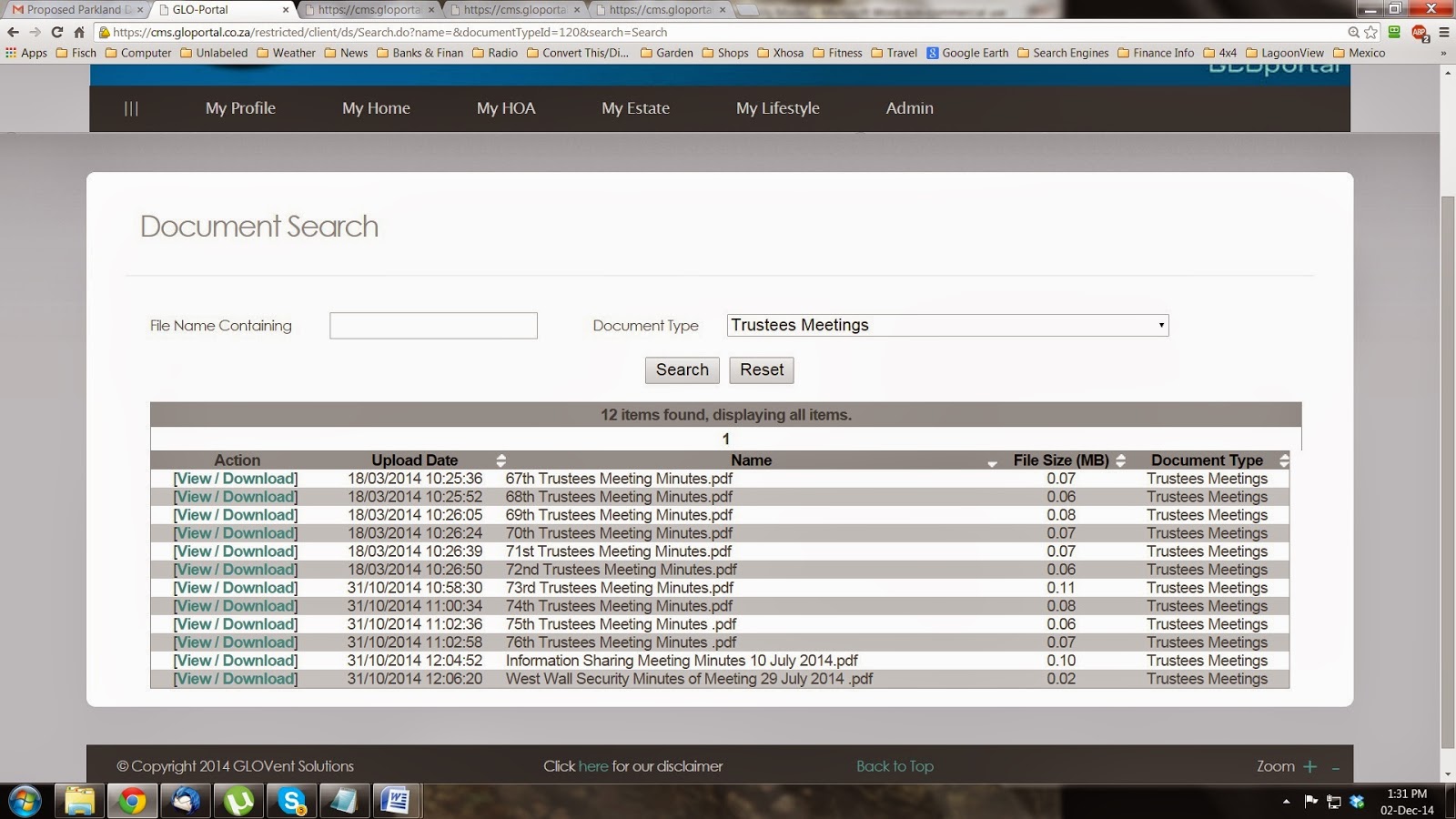
The April, June and August meeting's minutes were only posted on the HOA website on 31 October, 2014.  See the screen shot below.

There was no recorded discussion on the matter in the minutes of the April meeting. Just a reference to looking to other avenues for income.

I was not invited to the special meeting on 17 November. It appears it was by invitation only to a few home owners.

Your proposal was sent to all the homeowners on 22 November, 2014. 3 weeks after the minutes were posted! This is assuming home owners read the minutes on the day they were posted.  

Aside from the few home owners who you identified as “directly affected” who were notified on 30 October, the vast majority of home owners had 3 weeks’ notice of the plan. I live full time on Thesen Islands and I heard about the scheme in a coffee shop on 14 November.

The Trustees, also, do not wish to create a rift, disunity or animosity in our community. The Trustees believe that this would inevitably develop between Members if a vote is called.

This is a bit rich. The Trustees were the ones proposing a vote on cutting up the Parkland. Hindsight is perfect but how about some foresight? You couldn't anticipate that “a rift, disunity or animosity” would be caused when you called for a vote?

On a personal note, I wish to express my concern with the tone of some of the opinions. The Trustees have been called corrupt and there have been suggestions that they should be voted off. I wish to remind all Members that the Trustees give of their time, without any compensation, freely and without complaint.  

Surprised that people get hot under the collar when you propose building stands in the Parkland and boardwalks in front of their houses?  Adding 13 houses to the end of their cul de sac? Having to face more building and trucks in and out through the Gate House, all day, every day during the week for a few years? 

The Trustee’s lack of foresight caused a period of tension and unhappiness among home owners on Thesen Islands. Sadly, there is now distrust of the current Trustees. Many home owners were forced to spend hours of their time and lots of their energy fighting the proposals.  Also without compensation.

The best way to avoid criticism is to make no suggestions. I do not think this is what Members would expect from their Trustees.

No one would say that the Trustees should not come up suggestions. But this scheme was the wrong scheme, handled the wrong way, cost R108,000 and caused distress, tension and distrust on Thesen Islands.  

And no hint of an apology from the Trustee’s for this fiasco.

I am very sorry this has happened. It has been very unpleasant for many home owners, for you and your fellow Trustees. I look forward to starting the new year with a clean slate.  

Yours sincerely,
Ken Rutherford
P79


More Egg on Trustee's faces - Gray Rutherford responds with the Arcus Gibb Map to HOA dismissal of his statement regarding Parkland contamination

The area inside the highlighted border are the "Contamination Zones". See Map Key for details. This map formed part of the Arcus Gibb report that detailed the contamination of Thesen Islands.

I have highlighted the outline to make it easier to see. Looks like the outline of the Parkland, doesn't it? Read Gray's letter below and draw your own conclusions. 

Press "Control" and  the +" key to increase size of map. To reduce size, press "Control -"
 
"The Trustees and Dr Chris Mulder are well aware of the contaminated areas and the proposed development would not be located on contaminated land." 
- Excerpt from the letter from HOA Trustees to home owners, dated 2 December, 2014.

"The area shown for potential future houses is not contaminated and were not part of the previously identified contaminated areas. " 
- Excerpt from letter from Dr Chris Mulder, CMAI to Brian Sears, Chairman of the TIHOA, dated 28 November, 2014, and sent to home owners in letter dated 2 December, 2014.

Here is Gray Rutherford's letter:
To : Chairman, Thesen Islands Home Owners Association Trustees
Re : Parkland Contamination

I refer to my previous e mail to you dated 26 November 2014.  As I have not had the courtesy of a direct response, I am taking as your response the dismissal of my statement in the email you sent to Thesen Islands home owners on 2 December 2014.

I had thought that, in the interest of good governance, you would have independently investigated my statement that the full extent of the Parkland is a remediated contaminated area. Despite not wanting to become further involved in this sorry saga, your public rebuttal requires me to substantiate my statement.  (Bold added)

I attach a (reduced) contaminated areas plan ref J90299B – 3 dated June 2001 by consultants Arcus Gibb that identified the different contaminated zones on Thesen Islands.  It encompasses the full Parkland and includes the areas where you planned to develop 15 more residential stands.  This plan formed part of a report that detailed the contamination on Thesen Islands and the remediation plan and strategy agreed with the environmental authorities.

If you choose, you can verify this information with the records of the Department of Environmental Affairs and Tourism, the Department of Water Affairs and Forestry, the Knysna Municipality and the contamination consultants, Arcus Gibb.

In our increasingly urbanized world I believe the protection and preservation of our green spaces is the most important legacy we can pass on to our children, grandchildren and future generations.  

"We do not inherit the earth from our ancestors, we borrow it from our
children"   -  Native American proverb


Gray Rutherford
10 December 2014

Upcoming AGM - Elect Trustees who will push for the long term protection of the Parkland; Get/Give proxies for home owners who won't be at the AGM

I asked the HOA for a report on the current Trustee's terms of office:

Dear Ken

With reference to your e-mail dated 1 December 2014.

The following Trustees have resigned as from the date of the AGM:
Richard Wilkinson, Roel Goris and Mike Hennessy

The following Trustees have to stand down in terms of the rotation policy per the Constitution: 
Brian Sears, Hendri van der Merwe

Lester Day was co-opted as a Trustee during the year and has to stand down as a Trustee at the AGM. 

The following Trustees remain in office:
Suyenne Botha, Remia Eksteen, Noel Meier and Peter Hudson. 

I trust this answers your question.  Please feel free to contact me should you have any further queries.

Yours faithfully
Wiekie Smit

In summary, there are 10 Trustees of which
3 Trustees  will be resigning at the AGM; 
3 Trustees have to stand down;
4 Trustees remain in office. 

So according to this, 6 new Trustees are going to be elected at the AGM. Assuming the "co-opted" Trustee has to be replaced. I think that the 2 Trustee's who have to stand down, can offer themselves for re-election. 

Georgie Hudson (B7) has written that John Jacobs (H35, husband of Sustra), who was opposed to the cutting up of the Parkland may be willing to stand for election. 

Is there anyone else who will be willing to serve as a Trustee? We need to come up with a list of 6 preferred candidates that we will all vote for. 

Georgie also makes the good point that we need to get proxies from owners who will not be at the AGM. I have already got one from my neighbour. I should also be getting one other one. 

Let's all go on a proxy hunt! Ask your neighbours if they are going to the AGM and if not, ask for their proxy. Proxy forms were sent with the AGM material a few days ago. 

We can increase our clout by collecting as many proxies we can. 


Saturday, November 29, 2014

I never thought...the real threat to the Parkland would be of an invasion led by HOA Trustees

Here is my letter to the Trustees of the HOA. 

This is the covering email:: 

Your scheme is flawed and the way you have gone about it can only be interpreted as disdain for the homeowners. 

Why does your scheme get the full treatment in you email presentation while opposing views get only a few selected (by you, needless to say) paragraphs? There is no justification for this unequal treatment.  It smacks of bias.

I want my email be sent to all homeowners.

I am not asking that you hand over the mailing list, but you are obligated to allow opposing viewpoints be presented in the entirety by email, like you presented your scheme. 

In anticipation of a probable reply that opponents can do that at the AGM, I reject that.  There is not enough time to do that at the AGM. Letters, such as those written by Rolf and Jacqueline Lamprecht and Jennifer Wilkinson need time to be read and to digest. 

I look forward to your reply to this letter and my email.  

I, and many other homeowners, are also waiting on your response  to my brother, Gray's letter. 

Here is my letter:

Date: 27 November, 2014

To: The Trustees of the Thesen Islands Homeowners Association

From: Ken Rutherford – P79

I worked in the Thesen Islands Sales Centre for all the years the stands were being sold. A number of “up country” buyers were nervous about having Parkland near their house - a kneejerk reaction to squatter invasions. I would say to them: “Look at the open space as free ground. You get to enjoy looking over it, the birds will love it, your kids can play on it, you don’t have to maintain it and…. it will never be invaded!”

I never thought for one moment that the real threat to the Parkland would of an invasion led by HOA Trustees.

When a number of you Trustees bought your stands, I was the one answering your questions. I represented to you what the development would comprise by means of the Master Plan and sales literature. You bought on what was represented to you.

Say you had come back into the Sale Centre a few months later and found that there was no longer a waterway in front of your future home. Or the open ground near your home was now earmarked for more stands. Or that no main beach, no clubhouse, no tennis and no squash courts were going to be built.  You would have been outraged.

You would have said “Ken that is not what was represented to me when I bought my stand. It is completely unacceptable. You cannot take away part of what I bought.”

And I said to you: “Well, we have polled the other buyers and half of them don’t want the (fill in the blank) and you going to get a rebate of R (fill the amount of money saved by not building the (fill in the blank) divided by all the buyers).”   Would that have made you happy?  I don’t think so.

But with your proposed development scheme, you are advocating taking away from what your fellow homeowners bought into.  Surely, being a trustee means looking after the interests the homeowners?

I don’t know the owner of P89 but this stand borders the Parkland and has wide views over it. It is a lovely position and I considered buying it. You now plan to build a house on the Parkland next to his home.  Do you not realize that the enjoyment and value of his home would be substantially diminished?

Did none of you think that some, if not all, of the homeowners on the Eastern end of Plantation Point probably bought there because it was a cul de sac with only a few houses?  Yet you plan to take away from what they bought by adding 13 houses. I live on a cul de sac and the limited number of houses beyond me was a major reason we bought there. 

One of the reasons we, and others, decided to make our homes on Thesen Islands because there was Parkland. Yet you propose that if half of the homeowners want to cut up the Parkland, those of us who want it to remain as it was represented to us when we bought our stands, must accept it. We will not.

As Trustees, you must know the history of the contamination and remediation of the Parkland area and the ongoing environmental monitoring.  This is the very area where you plan to develop stands. 

Have you not wondered why P89 and P90 are the most easterly stands on Plantation Point? Why didn’t the Thesen Islands Development Company develop more stands there?   The Thesen Islands Development Company did not develop stands there because of the contamination and remediation. But this is where you plan to develop 13 stands.

You have failed the homeowners. You should resign and let new Trustees take your place. Let us have Trustees who understand what looking after the interests of the Homeowners means.

The proposal is "a betrayal of our trust...and a threat to our quality of life as well as our financial investment" - Rolf and Jacqueline Lamprecht's letter to Brian Sears, Chairman of the HOA

From their letter below:

We see the proposal as a betrayal of our trust in these matters and a threat to our quality of life as well as our financial investment in our property.

“How would New-Yorkers feel if Central Park is to be sacrificed to raise funds for the city?”


                                       P97,  4th November 2014

RESPONSE TO THE PROPOSAL OF THE DEVELOPMENT OF THE SOUTHERN PARKLAND


Dear Brian

Thanks for briefing us on the proposed development of the southern parkland.

It is with great alarm and considerable concern that Jacqueline and I read about plans to develop this area.

Thesen Islands is a high-density development where public areas serve a vital role in the success of the venture. They have an aesthetic, recreational and environmental function. In many ways they are the life-blood of the community.

When we decided to buy a property and settle on the island, the parkland and the opportunities it offered was one of the main considerations. The greenbelt was more attractive to us than living on a canal. We were particularly attracted to our erf as it is in a quiet cull de sac with little traffic. We believed that these areas were sacred, protected from development at all costs.

We see the proposal as a betrayal of our trust in these matters and a threat to our quality of life as well as our financial investment in our property.

You state that the area is “underutilized”. This is simply not true. Our family constantly make use of this space. We love to walk and play there. We enjoy the magnificent views across the lagoon and above all the open space. Many others do the same. It would be exceptionally short sighted to develop this area. While the golf course itself is underutilized, and I understand must be a considerable financial burden to maintain, it could be re structured to natural wetlands similar to the pond area north of the dog run.

How can the addition of 15 houses possibly “beautify” one of the only open and fairly natural parts of the islands?

Having broadly explained our feelings, we would like to list our concerns:

1)     The conversion of public parkland to housing is a major blow to the nature of our environment here on Thesen Islands.
2)     Doing this is a breach of the trust we place in the custodians of our estate and comparable to a government changing the constitution of a country to suit their current strategy.
3)     We and other homeowners will loose a large part of our “lebensraum”.
4)     Our road will carry much more traffic ( at least 30 more cars), disturbing our peace and threatening our children’s safety.
5)     The area earmarked for housing is an important habitat for birds, notably the Orange-throated Longclaw, Levaillant’s Cisticola and the Spotted Thick-knee. All above-mentioned birds breed in this area. This area has, for the first time, a resident Spotted Eagle-owl.
6)     It would be short sighted and reprehensible to develop housing in a green belt when we live in an area where nature is protected within the area of the Garden Route National Park.
7)     We have more to gain in the long run by leaving the area as communal parkland than building houses on the only truly open area on Thesen Islands.
8)     During the construction phase, which will last many years, there will be major disruption to our local environment and quality of life.


With regards to future budget planning and paying for the continued upkeep of the estate, our feelings are as follows:
The estate was originally developed fully to its current extent. Planning for the upkeep should be possible within the current structure with sound financial planning and management without altering the core structure of the estate. If additional funds need to be raised this should be done without changing our environment profoundly.

The real beneficiaries of the proposal for development of the southern parkland are not the homeowners but the service providers for the development.

We prefer options 1 and 2 in your list of proposals.

Some of the proposed changes to the parkland are good and will enhance the lifestyle of the homeowners but the proposed new housing will certainly not. Within the context of the current proposal including the additional 15 properties, we see the positive proposals as mere “sugar-coating”.

We hope you consider this letter and see it as constructive criticism. We appreciate the work you do and the need for you to plan for the future. We all have the best for our environment of Thesen Islands at heart.

“How would New-Yorkers feel if Central Park is to be sacrificed to raise funds for the city?”

Yours sincerely


Rolf and Jacqueline Lamprecht